One of the words I hear most often in boardrooms is strategy.
Everyone agrees it is important.
Many organisations have strategic plans, strategic sessions and strategic documents.
Yet I’ve often wondered whether we’ve sometimes mistaken planning for strategy.
Over the years, I’ve found myself thinking about strategy differently.
Perhaps strategy isn’t a document.
Or a presentation.
Or even a list of aspirations.
Perhaps it’s a series of deliberate choices.
It is deciding what matters most.
It is deciding where an organisation will compete.
It is deciding what it will not pursue.
And perhaps most importantly, it is deciding what future is worth committing resources, energy and leadership to create.
Without those choices, I sometimes wonder whether planning simply becomes activity rather than direction.
I’ve seen organisations work incredibly hard while making very little progress.
Not because the people lacked capability.
But because every opportunity looked equally important.
Every new idea became another priority.
Every priority competed for the same limited time, capital and attention.
Eventually, nothing received enough focus to succeed.
Clear choices seem to change that.
When strategy becomes a genuine choice rather than a collection of ambitions, decision-making becomes simpler.
Resources become more focused.
Leadership becomes more aligned.
People begin to understand not only what they are building, but why.
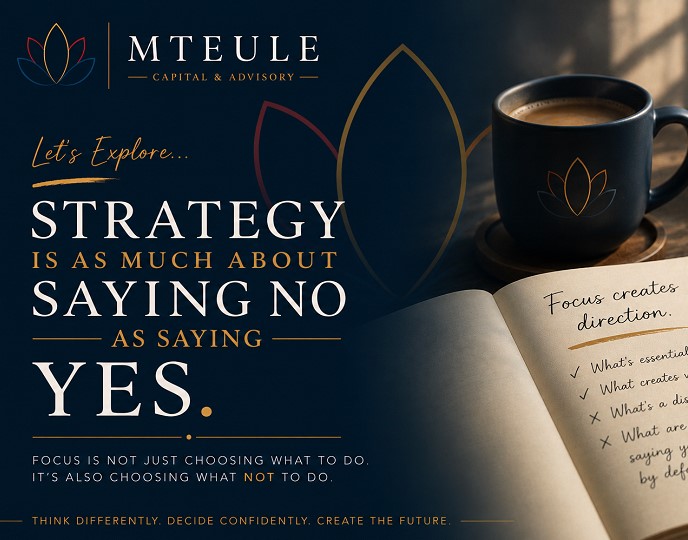
I’ve come to suspect that saying no is often more valuable than saying yes.
Every organisation has limited resources.
Every leadership team has limited capacity.
Choosing where not to invest is often as important as deciding where to invest.
Perhaps that’s where confidence begins.
And where trust begins to grow—with employees, customers, investors and partners alike.
Looking back across the organisations I’ve worked with, the ones that create lasting value rarely try to become everything to everyone.
They make deliberate choices.
Then they commit to those choices consistently over time.
Perhaps that’s why I’ve come to think about strategy differently.
Not as a document.
But as the courage to choose.
To choose what matters.
To choose what doesn’t.
To choose what deserves an organisation’s limited time, energy and attention.
Maybe strategy is less about saying yes…
and more about knowing when to say no.
What do you think?
— Nkuli Mkhize

The Best Funding Strategies Rarely Start with Funding
Capital Follows Confidence There is a common assumption in business that capital creates confidence. Raise the funding. Secure the investment.